
Begin among Dushanbe’s museums and the lakes of the Fann Mountains, then follow the Panj River into the Wakhan Corridor. Cross high Pamir passes to Karakul and return through the remote Bartang Valley.
EXPLORER COLLECTION / TAJIKISTAN
Roof of the World – Pamir and Wakhan Expedition
Fann Mountains • Wakhan Corridor • Karakul and Bartang Valley
Cross Tajikistan from the Fann Mountains to the Pamirs
14 DAYS / 13 NIGHTS • END MAY – END SEPTEMBER • STARTS AND FINISHES IN DUSHANBE
For travellers who accept long drives, rough mountain roads, simple shared homestays and travel above 4,000 metres.
Group size: 6 – 16 participants (4 pax per Jeep or 3 pax per Jeep)
THE JOURNEY AT A GLANCE
From the Fann Mountains to the Bartang Valley
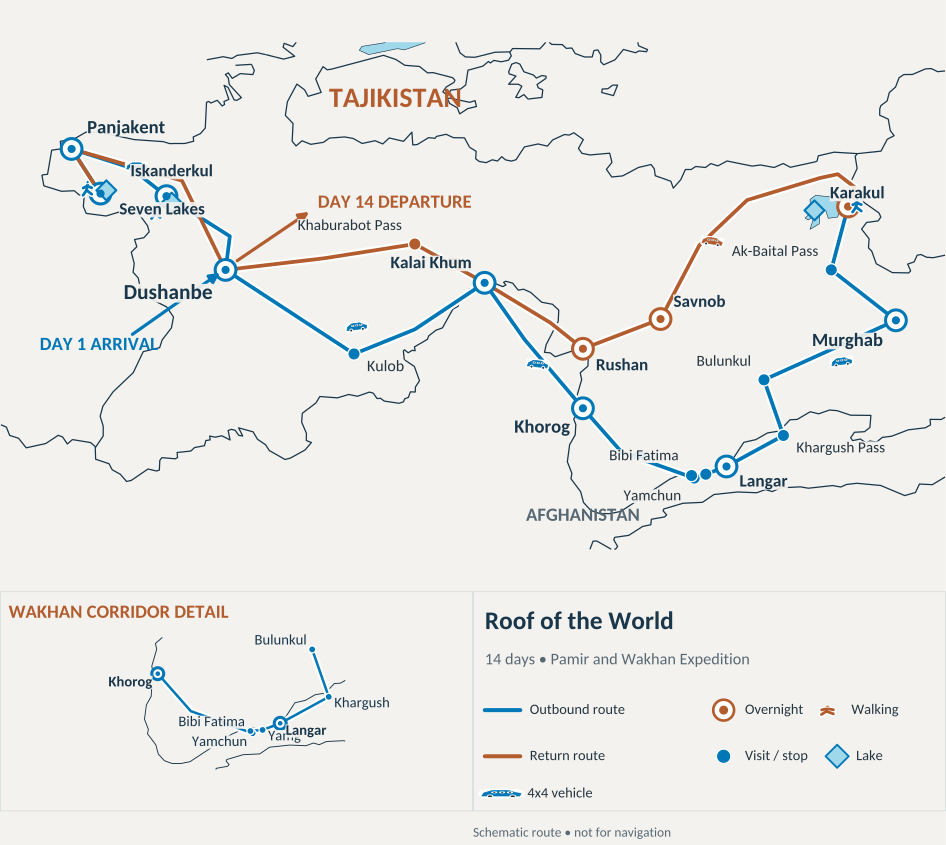
This expedition combines Tajikistan’s cultural sites with a demanding overland route through the Pamirs. You travel from Iskanderkul and Panjakent to the Afghan border, the Wakhan Corridor, Murghab, Karakul Lake and the Bartang Valley.
Your route
Dushanbe → Iskanderkul → Panjakent → Seven Lakes
Capital sights, Sogdian history and the mountain lakes of the Fann range
Dushanbe → Kulob → Kalai Khum → Khorog
The Pamir Highway and the Panj River along the Afghan border
Khorog → Wakhan Valley → Langar
Pamiri villages, Yamchun Fortress and Bibi Fatima Hot Spring
Langar → Bulunkul → Murghab → Karakul
High passes and the open plateau of the Eastern Pamirs
Karakul → Savnob → Rushan → Dushanbe
The rough Bartang Valley road and the Western Pamir Tract
Highlights
Is this journey right for you
Several days involve six to eight hours of driving, including rough and variable roads. The route reaches 4,655 m and uses simple shared accommodation in remote villages. Short walks can be adapted to local conditions.
STAYS HOTELS GUESTHOUSES AND HOMESTAYS • MEALS BREAKFAST AND DINNER • GROUP SIZE 5 TO 15 PARTICIPANTS
Fountain and Independence Monument in Dushanbe, the Capital of Tajikistan
Day 1 Arrival and Dushanbe city tour
Meet your guide at the airport and transfer to your hotel. After time to rest, visit Somoni Square, Rudaki Park and the National Museum, where the collection includes the reclining Buddha. See the city’s flagpole and principal government buildings. A bazaar visit is optional.
OVERNIGHT DUSHANBE • 4-STAR HOTEL • FULL BOARD
Day 2 Dushanbe to Iskanderkul
Drive through the Fann Mountains by way of the Anzob route to Iskanderkul at 2,255 m. Walk along the deep-blue lake and visit the nearby waterfall known as Fann Niagara. If time allows, take another short walk before settling in near the lake.
DRIVE APPROX. 130 KM / 3 TO 4 HOURS • OVERNIGHT ISKANDERKUL • GUESTHOUSE •
Iskanderkul, Tajikistan – A large body of water surrounded by mountains
Day 3 Iskanderkul to Panjakent
Continue through the Fann Mountains and descend into the greener Zeravshan Valley. In Panjakent, visit the UNESCO World Heritage site of Sarazm and the ruins of ancient Panjakent, where houses, temples and frescoes recall the Sogdian city that flourished more than 1,500 years ago.
DRIVE APPROX. 160 KM / 4 TO 5 HOURS • OVERNIGHT PANJAKENT • 3-STAR HOTEL
Day 4 Panjakent to the Seven Lakes
Follow a mountain valley through Haft Kul, a chain of seven lakes whose water shifts between blue, turquoise and green. Stop for short walks and photographs, then continue towards Hazorchashma, the highest lake, before staying beside the fourth lake.
DRIVE APPROX. 60 TO 70 KM / 2 TO 3 HOURS EACH WAY • OVERNIGHT SEVEN LAKES • 3-STAR HOTEL
Wakhan valley and Panj River between Tajikistan and Afghanistan
Day 5 Seven Lakes to Dushanbe
Return through the mountain valley to Panjakent and continue to Dushanbe by way of the Anzob route. Pause for rest, photographs and lunch at your own expense before arriving in the capital in the afternoon or evening.
DRIVE APPROX. 250 KM / 5 TO 6 HOURS • OVERNIGHT DUSHANBE • 4-STAR HOTEL
Day 6 Dushanbe via Kulob to Kalai Khum
Begin the Pamir Highway journey through gorges and mountain passes. After reaching the Panj River, follow the Afghan border past small settlements, farms and grazing livestock. Arrive in Kalai Khum in the evening.
DRIVE APPROX. 350 KM / 7 TO 8 HOURS • OVERNIGHT KALAI KHUM • 4-STAR HOTEL
Ancient Yamchun silk road fortress in Wakhan corridor with Afghanistan in background, Gorno-Badakhshan, Tajikistan Pamir
Day 7 Kalai Khum to Khorog
Continue beside the Panj River on a mixture of paved and rough mountain roads. Narrow valleys, cliffs and villages line the route, with Afghanistan visible across the water. Reach Khorog, at the meeting of the Panj and Gunt rivers, and enjoy time to rest or walk in town.
DRIVE APPROX. 240 KM / 6 TO 7 HOURS • OVERNIGHT KHOROG • 3-STAR
Day 8 Khorog through the Wakhan Valley to Langar
Enter the Wakhan Valley with views of Afghanistan and the Hindu Kush. Visit Yamchun Fortress and stop at Bibi Fatima Hot Spring. In Yamg, learn about the Sufi scholar Mubarak-i Wakhani and his work in astronomy before continuing to Langar.
DRIVE APPROX. 250 KM / 6 TO 7 HOURS • OVERNIGHT LANGAR • GUESTHOUSE
Karakul lake aerial panoramic view in Tajikistan
Day 9 Langar via Bulunkul to Murghab
Leave the green Wakhan Valley and climb through the remote Khargush Valley to Khargush Pass at 4,344 m. The landscape opens into high desert and yak pasture. Continue by Bulunkul to Murghab, Tajikistan’s highest town at approximately 3,650 m.
DRIVE APPROX. 270 KM / 6 TO 7 HOURS • OVERNIGHT MURGHAB • 2-STAR HOTEL
Day 10 Murghab via Karakul to Savnob
Cross the Pamir Plateau and Ak-Baital Pass at 4,655 m, the route’s highest point. Walk beside Karakul Lake at approximately 3,900 m, then descend from the plateau and continue towards Savnob in the Bartang Valley.
DRIVE APPROX. 300 KM / 7 TO 8 HOURS • OVERNIGHT SAVNOB • SHARED HOMESTAY
Mountains along high-altitude Pamir Highway between Ak Baital and Karakul, Murghab, Gorno-Badakshan, Tajikistan
Day 11 Savnob to Rushan
Follow the Bartang River through narrow gorges, rough terrain and isolated villages. The road offers a close view of rural Pamiri life before the valley widens and rejoins the main Pamir Highway near Rushan. Road conditions vary and will determine the day’s pace.
DRIVE APPROX. 150 KM / 5 TO 7 HOURS • OVERNIGHT RUSHAN • GUESTHOUSE
Day 12 Rushan to Kalai Khum
Return along the Panj River with Afghanistan across the water. Although this section repeats part of the outward route, the changing light and viewpoints reveal different aspects of the valley. Arrive in Kalai Khum in the afternoon.
DRIVE APPROX. 200 KM / 6 TO 7 HOURS • OVERNIGHT KALAI KHUM • 4-STAR HOTEL
landscape in Pamir Region in Tajikistan
Day 13 Kalai Khum via Khaburabot Pass to Dushanbe
Take the less-travelled mountain road over Khaburabot Pass at approximately 3,250 m. The rugged route passes deep valleys, traditional villages and pastoral landscapes before descending towards Dushanbe. Arrive in the afternoon or evening.
DRIVE APPROX. 300 KM / 7 TO 8 HOURS • OVERNIGHT DUSHANBE • 4-STAR HOTEL
Day 14 Departure
Transfer to the airport in the morning for your onward flight.
AIRPORT TRANSFER INCLUDED • BREAKFAST SUBJECT TO FLIGHT TIME
A journey through culture and high mountains
Over 14 days, the route connects Sogdian heritage and the lakes of the Fann Mountains with the Panj River, Wakhan villages, the Eastern Pamir plateau and the isolated Bartang Valley.
YOUR STAY AND INCLUDED SERVICES
Hotels guesthouses and village homes
Stay in 4-star, 3-star and 2-star hotels in the principal towns, with guesthouses near Iskanderkul, the Seven Lakes, Langar and Rushan. In Savnob and other remote areas, accommodation is in traditional local homes with shared facilities.
Homestay arrangements
Village houses usually have three to four rooms. Three or four travellers may share a room and sleep on thick mattresses rather than standard beds. Toilets and showers can be outside in the garden. Larger groups may stay in several nearby homes. The single supplement applies only to hotel nights.
Included in the programme
Transport and guiding
Not included
BEFORE YOU TRAVEL
Prepare for remote mountain travel
Pace and road conditions
This is a demanding road expedition. Several stages take six to eight hours, and the Bartang Valley and high passes can be rough. Weather and road conditions may require changes to timings or routing.
Altitude and health
Some itineraries take place at high altitude.
The journey reaches 4,655 m at Ak-Baital Pass and includes a night in Murghab at approximately 3,650 m. Discuss high-altitude travel with a medical professional if you have a relevant health condition. Allow for cold, wind and rapid weather changes even in summer.
If you have any chronic medical conditions or other health concerns that may affect your ability to travel at altitude, we recommend consulting your doctor before the trip.
Insurance and documents
Travel insurance is not included. Arrange cover for remote road travel, altitude, medical treatment and evacuation. Visa and visa support are excluded.
The GBAO permit is included.
Meals
Full Board.
What to expect in villages
Homestays are family homes rather than purpose-built tourist accommodation. Rooms and facilities are shared, and bathroom facilities may be outside. Flexibility and respect for household customs are essential.
PRICES AND BOOKING
Price from € 2750 p.p.
Option 1 Four travellers per 4×4
Option 2 Three travellers per 4×4
Plan your expedition
We will confirm the route, current road conditions and accommodation for your journey through the Fann Mountains, Wakhan Corridor, Karakul and Bartang Valley.
REQUEST YOUR PERSONALISED QUOTATION FROM ARVENTPULSE TRAVEL